Sean,
Just throwing out a few reasons why I think it's plausible that racism plays a significant role in keeping black head coaches out of head coaching positions in FBS college football.
1. You're right that the kind of probabilistic reasoning that I was engaged in will never prove that a particular decision not to hire a black man is racially motivated. The fact that African Americans are represented in lower numbers among the ranks of FBS head coaches than they are among the population at large doesn't prove anything. But it does lead us to ask for reasons why such a disparity might exist. It could be that white guys generally possess qualities that would make them better college head coaches, just as nobody seems to bat an eyelash if you draw a conclusion that young black men must generally have qualities that make them better football players than young white men, since they are overrepresented on the football field. But I don't think that my concern has been answered just because other possibilities are plausible. Speculation is all we have at this point, but I'd prefer to answer the question with data, if it were available.
2. You write that you can't think of a single instance in which a head coach hiring decision stuck out to you as being racially motivated. I think it would be surprising if one had. Your observation is salient for what it is, but it doesn't preclude use of race as a "tiebreaker." That is, assuming that a black candidate and a white candidate are relatively equal in terms of merit, a hiring committee still might systematically choose the white candidate. As long as the true basis of the decision is hidden, no one could reasonably accuse that particular hiring committee of racism. But if the same methodology is applied at a number of schools, the numbers would begin to look suspiciously like the ones we in fact encounter.
3. Racism could be outsourced to smaller schools or less pressworthy positions. Everybody knows that hiring a new head coach at a major conference school attracts lots of press scrutiny. This is less true at mid-major schools or in the FCS, and also of coordinator positions, position coaches, and the rest, on down the line. If race is used as a factor at those levels, it is less likely to be detected since people are less likely to crunch those numbers. But the results would still be felt at the head coach level because policies like these would yield fewer qualified black candidates at the coordinator level, or as head coaches at mid-majors.
4. You write that it's inconceivable to believe that anything matters to a hiring committee more than W's. Actually, I think you mention something that could matter more to them: $$$. You write as though there's a one-to-one correspondence between wins and profits, and certainly that correlation is very strong. But money comes from other places; in particular, from booster fund raising. If the hiring committee fears that the boosters will not take well to a black head coach (which would not be an unreasonable concern here in the South), then they might pass over a more qualified black coach on that basis alone, unless the expected profits from his greater number of wins would outstrip the losses the school would suffer from decreased booster support.
Showing posts with label race. Show all posts
Showing posts with label race. Show all posts
Wednesday, March 4, 2009
Thursday, February 19, 2009
Racist? Really?
Is this cartoon offensive?
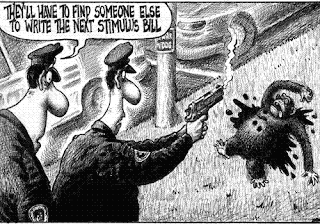
I'm participating in a long-term survey conducted by politicshome.com, pursuant to which I receive one or two emails per week prompting me to answer a short series of opinion questions about the news of the day. This morning, the email contained the following sentence: "Today, we approach the delicate subject of race." I clicked the link, and was greeted with the above cartoon, along with some explanatory text:
This is what ran through my head when I saw the cartoon. I drew the conclusion that the cartoonist had in mind to intimate that the stimulus was such a poor bill that even a chimpanzee (on downers) could have drafted it. Which is pretty much what you would expect a New York Post cartoonist to say. So was it offensive? I thought that it was somewhat tasteless to take advantage of this lady's plight to make a relatively crass point about a totally unrelated political event, and particularly to do so in such a patently unfunny way. But tasteless isn't offensive. I clicked "No."
Still, I continued to think about it. After all, the email from PoliticsHome had primed me for a question about race. I am an intelligent and educated man, and I am by no means ignorant of the fact that the history of rhetoric regarding race in our nation includes not just a few instances of black men being lumped in with lower primates by people with political and eugenic axes to grind. So I sat a while and tried to spin a sensical interpretation of the cartoon that would play on that outdated and obviously offensive symbolism.
I couldn't come up with anything that made sense to me. For the cartoon to operate in that way, you would have to read it as blaming black people for drafting a shoddy bill, which doesn't fly, since Congress drafted the bill, and most members of Congress are white. Anyway, I finally decided, if there was an offensive racial interpretation to the cartoon, it was too subtle for me to detect, so I left my answer as it was.
It was only later in the morning when I came across editorials by Roland S. Martin and Keith Josef Adkins explaining what was purportedly offensive about the cartoon. Martin writes:
And now listen to Martin's explanation for why this connection is so obvious:
Adkins, on the other hand, didn't go out on a limb to say that the cartoon chimp represented Obama in particular, but did write, "I'm sorry, there's no way to interpret a cartoon like this except as racist filth." I just disagree. The cartoon clearly CAN be interpreted as racist filth, but only if the interpreter is predisposed to read racial animus into found cultural objects. I think it can be interpreted as just tactless and unfunny.
Look, I'm not accusing these two columnists, or the many people who agree with them, of manufacturing umbrage in response to the cartoon. I have no reason really to believe that they are being anything but sincere in taking offense to it. I suspect that this is just one area where different upbringings coax out wildly different interpretations of the same cultural object, and not a great deal can be done about that. So I recognize that it's possible to have caused legitimate offense without having intended to do so, and that maybe in such a case, an apology is warranted. But these cases of cross-racial misunderstanding are so common that it's time for both sides to start adjusting their expectations. As a white guy, I just don't have a radar for this stuff. If I offend somebody, it's not insensitivity or malice; it's just that I'm operating on a different set of symbols from the one that would help me avoid putting my foot in my mouth about these things. It's the same way that I can walk past a pile of dishes in the sink for days on end, as Katy steadily boils over in anger: to me, those dishes are not saying "Wash us!"
To finish up, I think it bears saying explicitly that white people generally don't assume that depictions of apes in editorial cartoons are representative of African Americans in general, or of President Obama in particular. Quite the contrary in fact. When I imagine a simian as a symbol for the chief executive, a president of a different vintage comes to mind. Anyone remember the Smirking Chimp?
I'm participating in a long-term survey conducted by politicshome.com, pursuant to which I receive one or two emails per week prompting me to answer a short series of opinion questions about the news of the day. This morning, the email contained the following sentence: "Today, we approach the delicate subject of race." I clicked the link, and was greeted with the above cartoon, along with some explanatory text:
The New York Post ran this cartoon in their newspaper yesterday, and it has sparked a controversy. The image is of a chimpanzee having been shot by police. The text reads: "They'll have to find someone else to write the next stimulus bill." Do you think this is offensive?The media has been all atwitter with the story of the woman in Connecticut who was almost mauled to death by her friend's trippin' pet chimpanzee. After the attack, the owner called 911, and the police were dispatched, at which point they shot and killed the ape. The victim was so badly mutilated that the police thought she was a man when they came upon her body. The last I read, she was in critical but stable condition.
This is what ran through my head when I saw the cartoon. I drew the conclusion that the cartoonist had in mind to intimate that the stimulus was such a poor bill that even a chimpanzee (on downers) could have drafted it. Which is pretty much what you would expect a New York Post cartoonist to say. So was it offensive? I thought that it was somewhat tasteless to take advantage of this lady's plight to make a relatively crass point about a totally unrelated political event, and particularly to do so in such a patently unfunny way. But tasteless isn't offensive. I clicked "No."
Still, I continued to think about it. After all, the email from PoliticsHome had primed me for a question about race. I am an intelligent and educated man, and I am by no means ignorant of the fact that the history of rhetoric regarding race in our nation includes not just a few instances of black men being lumped in with lower primates by people with political and eugenic axes to grind. So I sat a while and tried to spin a sensical interpretation of the cartoon that would play on that outdated and obviously offensive symbolism.
I couldn't come up with anything that made sense to me. For the cartoon to operate in that way, you would have to read it as blaming black people for drafting a shoddy bill, which doesn't fly, since Congress drafted the bill, and most members of Congress are white. Anyway, I finally decided, if there was an offensive racial interpretation to the cartoon, it was too subtle for me to detect, so I left my answer as it was.
It was only later in the morning when I came across editorials by Roland S. Martin and Keith Josef Adkins explaining what was purportedly offensive about the cartoon. Martin writes:
If you haven't seen the editorial in question, it shouldn't take you long to figure out that the subtle message was clear: comparing President Obama to a chimpanzee.WHOA! Wait a minute! Seriously? I stared at the cartoon for five minutes, actively trying to suss out what was supposed to be racist about it, and I never, NEVER would have made this supposedly obvious connection. It makes no sense at all. President Obama didn't draft the stimulus bill; Congress did.
And now listen to Martin's explanation for why this connection is so obvious:
First, mixing the two stories [the chimp attack and the stimulus] is ridiculous. Yes, the chimpanzee incident and the passage of the stimulus bill have a lot of folks talking, but to put them in the same element just doesn't make sense.As to the first argument, about what percentage of the political cartoons that you read make a hell of a lot of sense? My hunch is that this number hovers between 20% and 30%. As to the second, I think it makes my point just as effectively as it makes Martin's own: if it is "left up to the reader to determine exactly who the cops are referring to," doesn't that imply that the reader chooses whether to interpret the cartoon in a way that he or she finds offensive?
Second, the cartoonist didn't hang a sign around the neck of the chimp, so he left it up to the reader to determine exactly who the cops were referring to.
Adkins, on the other hand, didn't go out on a limb to say that the cartoon chimp represented Obama in particular, but did write, "I'm sorry, there's no way to interpret a cartoon like this except as racist filth." I just disagree. The cartoon clearly CAN be interpreted as racist filth, but only if the interpreter is predisposed to read racial animus into found cultural objects. I think it can be interpreted as just tactless and unfunny.
Look, I'm not accusing these two columnists, or the many people who agree with them, of manufacturing umbrage in response to the cartoon. I have no reason really to believe that they are being anything but sincere in taking offense to it. I suspect that this is just one area where different upbringings coax out wildly different interpretations of the same cultural object, and not a great deal can be done about that. So I recognize that it's possible to have caused legitimate offense without having intended to do so, and that maybe in such a case, an apology is warranted. But these cases of cross-racial misunderstanding are so common that it's time for both sides to start adjusting their expectations. As a white guy, I just don't have a radar for this stuff. If I offend somebody, it's not insensitivity or malice; it's just that I'm operating on a different set of symbols from the one that would help me avoid putting my foot in my mouth about these things. It's the same way that I can walk past a pile of dishes in the sink for days on end, as Katy steadily boils over in anger: to me, those dishes are not saying "Wash us!"
To finish up, I think it bears saying explicitly that white people generally don't assume that depictions of apes in editorial cartoons are representative of African Americans in general, or of President Obama in particular. Quite the contrary in fact. When I imagine a simian as a symbol for the chief executive, a president of a different vintage comes to mind. Anyone remember the Smirking Chimp?
Subscribe to:
Posts (Atom)