Showing posts with label aesthetics. Show all posts

Wednesday, February 4, 2009

My Chemical Romance Covers Dylan: I Have an Opinion About That, and It's Not (Exactly) What You Think

I think it was Monday evening when Katy came home and told me that My Chemical Romance was contributing a cover of Bob Dylan's "Desolation Row" to the soundtrack of the upcoming film, Watchmen. Before even hearing the song, I was nonplussed, and remained so afterwards. They tossed some verses, sped it up, applied their traveling circus style of buzzsaw guitar, lifted a riff straight out of Poison's "Talk Dirty to Me," and got it down to 3 minutes. And they missed the boat entirely.

I should probably start by saying that although not my cup of tea, the problem is not that My Chemical Romance is contributing the cover. Katy owns two of their albums, I've listened to them, and I don't hate them as much as I'd expected that I would. At their best, they sort of succeed as a dark-ish party band; in some places they actually sound like a successor to Twisted Sister, not great praise necessarily, but not all bad either. My biggest complaint with them is that it seems to me that their lyrics could benefit from another several drafts before hitting the CD press.

My problem is also not the problem that a Dylan purist might have. That is, I think that most Dylan songs can and should be covered. In fact, off the top of my head I can name several covers of his songs that kick his album versions in the teeth and don't quit.

Anyway, those paragraphs were tangents. My problem is not with My Chemical Romance, and my problem is not that the Dylanography is inherently untouchable. My problem is with the choice of song itself; I propose that "Desolation Row" belongs in a class of songs which I will denote "Uncoverable."

In fairness, it was practically inevitable that any attempt to film Watchmen would involve a cover of "Desolation Row," since the graphic novel actually quotes the song. In that connection, I can't help but be reminded of the making-of previews for Watchmen, in which the director says, more or less, "A lot of people think of Watchmen as the unfilmable graphic novel." It just strikes me as interesting that in order to film the unfilmable graphic novel, you have to cover the uncoverable song. Poetic, kinda.

I've heard the concept of uncoverability floating around before. On Last.fm, I remember someone complaining about Johnny Cash's cover of U2's "One," saying effectively that the song was so personal to Bono that any attempt to cover it becomes automatically crass. That's not precisely what I have in mind. I think that a song is uncoverable when the original recorded performance is so radically idiosyncratic that it forces the potential cover artist into a catch-22: either he copies the idiosyncrasy, in which case it swallows up his own contribution to the project, making the cover redundant, or he ditches the idiosyncrasy, in which case everyone wonders what was the point of performing a song whose most interesting aspect has been extracted.

The best relatively contemporary example that I'm coming up with is Bush's "Glycerine." Uncoverable I say. Why? Because the arrangement is completely anomalous, and yet it works so well that a casual listener could hear the song a hundred times and never notice what it is that makes the music so haunting: no percussion. Only vocals, fuzzed-out electric guitar, and a string section. If you were inclined to cover "Glycerine," what would you do? Jettison the attributes that make it sui generis, by incorporating drums? Or play it straight, omit the percussion, and allow the song itself and its history to overpower your performance of it? (The tragic choice might be avoided through schtick, say, by Me First and the Gimme Gimmes, but I have in mind serious covers, and not parodies).

So what is the radical idiosyncrasy of "Desolation Row"? I suggest you download it from iTunes and see for yourself, but failing that, read on:

First, at 11 minutes, 20 seconds, it is a radically long song, even for Dylan. The first 9 minutes or so are comprised of a sequence of verses featuring characters from and allusions to various works of art, literature, fairy tale, mythology, scripture, and history. Cameos are made by Romeo and Juliet, Cain and Abel, Cinderella, Casanova, Ezra Pound, T.S. Eliot, and the Phantom of the Opera, among others. Neither the melody nor the arrangement changes appreciably during this section, though changes in diction and emphasis will help to keep you interested. Each verse is essentially self-contained and unrelated to the others.

The other thing worth pointing out is that, while there are emotionally touching standouts (like the Ophelia verse), between one-quarter and one-third of the verses are absolute garbage from the perspective of being well-written or interesting or insightful. In particular I'm thinking of the verses beginning "Einstein disguised as Robin Hood..." and "At midnight, all the agents..." (Interestingly, that latter verse is the one quoted in Watchmen). It's perplexing then, at first, that those verses are there at all, since the song is already too long, and nobody would miss them if they'd been omitted, since they bear no real relation to the other parts.

Then, after all these verses, there is a harmonica interlude, and after it, a final verse, wherein we learn that the foregoing verses were all contained in a letter received by the speaker. The final verse is the speaker's response, and he's having none of it; in fact, he's bored, effectively mocking the audience for any enjoyment it might have derived in the previous ten minutes:

All these people that you mentioned,
Yes I know them—they're quite lame.
I had to rearrange their faces,
And give them all another name.
Right now I can't read too good.
Don't send me no more letters, no,
Not unless you mail them from Desolation Row.
And that's when it hits you that the radical idiosyncrasies at work in this song are the peculiar chutzpah that it must take for an artist to pull this sort of time-wasting, tear-jerking prank on his audience, and the charisma it takes to make them feel satisfied even after the rug has been pulled neatly out from under them. Dylan knows that he can string you along until the end, maybe move you to the brink of tears, or convince you to sing along, just by employing that timeless, nasal/gravel/gargle he calls a voice (maybe the closest we modern English speakers can come to hearing Beowulf sung), sprinkling some good lines and verses in among the bad ones, and mostly by appealing to the audience's ego: "I've heard of Ophelia!" It's Menippean satire meets the Shaggy Dog Story. It's the take that makes you love getting took.

And that's why it can't be covered. Now that "Desolation Row" is a classic, chutzpah and charisma are no longer required in order to get away with it. But it's the chutzpah and charisma that made it a classic in the first place. The reasons that undergird your desire to cover it are the very reasons why you'll never be able to bring anything to it that is new or interesting or relevant or really very good at all. You shouldn't bother trying.
Friday, January 16, 2009

Artists Offer Mindblowing APYs on Colossal Certificates of Deposit

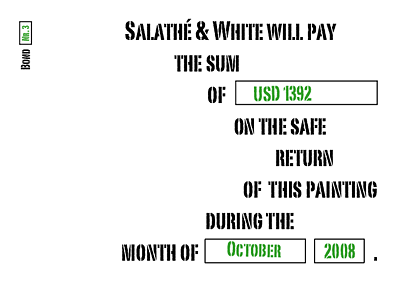
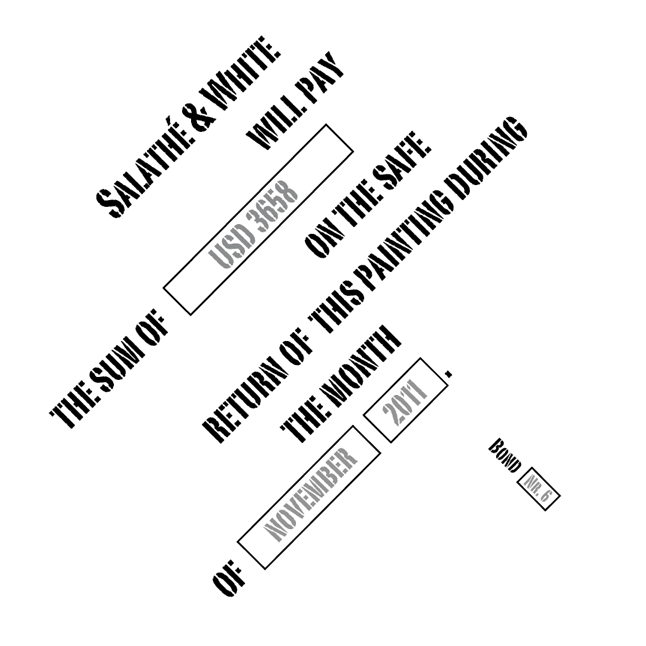
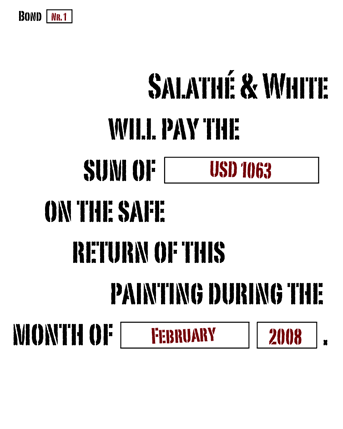
Marcel Salathé and Anthony White are a pair of artists undertaking a somewhat perplexing experiment involving art and economics. They take a canvas, paint words on it promising to pay a certain sum of money to the person who returns it to them, provided that person returns it during the month denoted on the painting. It looks like this.

You can think of it sort of like a certificate of deposit, except that it's on a square yard of canvas, and, if the maturity date expires, it won't roll over into a new CD; instead, you can't redeem it at all after that date.

My expectation would be that the novelty of a giant certificate of deposit that you can hang on the wall of your urban loft-style apartment with exposed ductwork would make these paintings sell at higher prices than CDs of the same face value that you purchase from your bank. Effectively, the artists ought to be able to offer a lower annual percentage yield (APY) than a bank does, because of the purported aesthetic value of the painting. In practice, this expectation has not always been borne out.

The series so far consists of six paintings, four of which have been sold. The maturity dates of two of the four sold paintings have passed (Bond Nos. 1 and 3). Bond No. 1 is pictured here to my left. Bond No. 1 promised $1,063 if it was returned during February 2008. The piece was sold at auction for $1,286. The painting was not returned, and so the artists netted $1,286. That's a good result for them. Not only did they sell a promise to pay $1,063 for more than $1,063, but the promise lapsed without being enforced. Not bad.

To my right now you'll see Bond No. 3, which promised $1,392 if returned during October 2008. Bond No. 3 was sold at auction on April 29, 2008 for $960, and was returned to the artists in October 2008. The artists then paid the returning party $1,392, and auctioned the painting again on eBay, where it sold this time for $242.50. All told, the artists netted a loss of $189.50 on Bond No. 3.

It seems to me that Bond No. 3 was worth well more than $960 when it was purchased, and that the reason it sold for so little must have had to do with the thin market (i.e., the fact that not many people knew about the auction). If you bought a CD for $960 that promised a return of $1,392 in five months, its interest rate would be 89%. That comes to a 144% APY. For comparison, if you buy a six-month CD from Chase today, it will buy you a measly 0.25% APY. Bond No. 3 was a steal at $960.

After Bond No. 3, the artists apparently learned their lesson, and stopped auctioning the paintings. Instead, they placed a fixed price on them. Bond No. 6, pictured at the top, lists for $2,699, and promises $3,658 if returned in November 2011. The comparable CD would have an interest rate of about 10.4%, for roughly an 11% APY, nowhere near as crazy high as Bond No. 3, but still a much, much better rate of return than would be available from a bank right now. In fact, an 11% APY is higher than you'd ordinarily expect in a decent year from stocks (and Lord knows we may be waiting a long time for another one of those); on a guaranteed investment 11% APY is mind-blowing. I say buy it if you have the cash on hand.

But doesn't this seem strange? Like I said above, the aesthetic value of the art ought to mean that the artists should be able to offer lower yields than banks. Instead they offer higher ones. It's almost like the aesthetic/novelty factor actually makes the painting worth less than a traditional CD. Are Salathé and White making a paradoxical or ironic statement about art values? Or are they just not performing the calculations that would tell them that they are grossly undervaluing their work?

Wednesday, January 7, 2009

Aesthetic Experiences for Artists

Sean,

I think you put your finger on something interesting where you suggest that it's easier to admire a work of art when one's own fingerprints are not the only ones on it. I think you're right that Vinnie might have an easier time admiring Less Than Jake's output as a result of its collaborative nature. But more on that in a second.

Likewise, I accept your correction regarding the chronological perspectives (short versus long term) from which Vinnie and Joey, respectively, were speaking. As I was wrapping up my last post in this thread, I think I had come to the conclusion that, really, that distinction was less important than the one between Joey speaking as an artist and Vinnie speaking as a promoter, but I never got around to saying so.

But let me go back to what you said about it being easier to appreciate other people's work than one's own. The more I think about it, the more I wonder if it's even possible to have an aesthetic experience of one's own work. I mean, I can talk about liking or not liking "Beer Goggles" using the same language that Joey Cape can. But if I say that I don't like it, do I mean the same thing that he means when he says that he doesn't like it? I don't think so.

It seems to me that as a listener, when determining whether I like a song, I determine how much awe it puts me in. (Of course, I'm using that word to cover more ground than it ordinarily would). But as a writer of music, if I ask myself whether I like a song I've written, I determine how much pride it induces in me. Maybe I'm wrong about this, but it seems to me that there is a qualitative difference between pride and awe; that is, a difference other than whether the emotion is self- or other-directed.

To put it in particulars, to the extent that I admire a poem that I've written, I don't think that my emotions are so much different from those of a contractor who admires the building he's just erected, or of a mechanic who admires his handiwork in repairing a broken engine. With respect to my own work, I can't get past the pre-aesthetic level: the level of craftsmanship. My emotions when reading my own work bear no resemblance to my emotions when I read Tennyson's "Ulysses" or Yeats' "Sailing to Byzantium"; those works elicit a tingle in me that my own do not, and I don't think it's only because they are much, much better than mine.