Showing posts with label politics. Show all posts

Thursday, May 28, 2009

The Sotomayor Nomination

Yesterday, I came across this in an opinion piece by Ilya Shapiro posted on cnn.com, criticizing President Obama's nomination of Judge Sonia Sotomayor to the Supreme Court:

[I]n over 10 years on the Second Circuit, she has not issued any important decisions or made a name for herself as a legal scholar or particularly respected jurist. In picking a case to highlight during his introduction of the nominee, President Obama had to go back to her days as a trial judge and a technical ruling that ended the 1994-95 baseball strike.

Moreover, Sotomayor has a mixed reputation among lawyers who have practiced before her, some questioning her abilities as a judicial craftsman, others her erratic temperament, according to a piece by Jeffrey Rosen in The New Republic, which itself has come in for criticism.

Such anecdotal criticism is to be taken with a grain of salt -- while Justice Antonin Scalia's bench-side manner is more vinegar than honey, even his detractors recognize his brilliance -- but it does need to be investigated. So, too, do certain statements she made in presentations at Berkeley and Duke, respectively, the former arguing that a Latina necessarily sees the law differently than a white man, the latter suggesting that, at least to some degree, judges make rather than interpret law.
Am I correct in reading this to mean that Shapiro's primary beef with Sotomayor is her lack of "brilliance"? I mean, he shrugs off criticisms of her demeanor (apparently on the grounds that any failing of Antonin Scalia's must not be a failing at all), but huffs and puffs that she is no "legal scholar," "respected jurist," or "judicial craftsman." Seriously, how important is brilliance?

Here's a lesson from the real world and the practice of law: past a certain point, additional intelligence provides only short-term advantages. Being smart means you'll pick up the concepts more quickly than others. It means you might be able to come up with cleverer or more intricate arguments, more quickly. But over the long haul, those benefits never trump experience in the trenches. Yes, the Supreme Court is a very important post, and an impressive intellect is an asset; but an astounding intellect is unnecessary.

Secondly, there seems to be something hypocritical (or at least dissembling) about Shapiro's admonition that Sotomayor "has not issued any important decisions or made a name for herself as a legal scholar or particularly respected jurist." To me, this reads as follows: "Judge Sotomayor has failed to leave a satisfactory smoking gun evidencing her liberal activism, which makes my job difficult, since I'm supposed to call her a liberal judicial activist. Therefore, I will paint her failure to stake out such liberal positions as evidence of her intellectual lethargy." In other words, had Sotomayor staked out any clever, novel, or interesting legal positions, Shapiro would be criticizing her for having taken those positions, instead of criticizing her, as he does here, for not having taken them.

Thirdly, Shapiro criticizes Sotomayor for commenting that judges make rather than interpret the law. If you read Shapiro's bio, you will see that he is a lawyer with an impressive-sounding resumé. This is surprising, because he is apparently quite a dim bulb himself. I attended a state law school, where I was taught by outspoken liberals and outspoken conservatives. Not one of them, regardless of their political persuasion, would have denied that in certain circumstances, a judge has the responsibility to make the law. "Interpreting, not making, the law," is something the public likes to hear about its judges, but it has never been the whole story.

Imagine this scenario: a criminal defendant has been tried in state court and found guilty of first degree murder. The jury deliberates, and votes 11-1 to impose the death penalty. A state statute provides that an 11-1 vote is all that is necessary to impose the death penalty. The defendant objects, saying that the state statute violates the Due Process clause of the Fourteenth Amendment, which ought to be interpreted to require unanimity in order to impose the death penalty. All the Due Process clause says is "No State shall... deprive any person of life, liberty, or property, without due process of law." So which is it? Does the Due Process clause require unanimity or is 11-1 good enough? Either answer is plausible, but you can't support either one just from reading the Due Process clause. Say yes or say no, but your decision is not extrapolated from the meaning of the phrase "due process"; your decision gives meaning to the phrase "due process."

The take-away point is this: when the drafters of the Constitution or the legislation punt, the judiciary has to pick up the ball.

Lastly (for now), Shapiro criticizes Sotomayor for remarking that a Latina and a white man necessarily view the law differently. I actually can join Shapiro in being a little riled by this comment. Obviously she's playing to crude racial stereotypes here. Behind it is something like the ethnic imaginings typified in Jennifer Lopez romantic comedies: Latinas are all sassy hotel maids, and white men are all running for the U.S. Senate. You might as well say that black men and Sicilians necessarily have different views on the law—but then how do you explain Justices Thomas and Scalia? These are oversimplifications that should make us all blush, and frankly they're offensive.

On the other hand, by adding a little nuance, I don't think Sotomayor is very far from the truth. I think it's true to say that there are a lot of factors that influence one's view of the law (upbringing, religion, socioeconomic status, etc.), and many of those factors, statistically speaking, break along ethnic, racial, and gender lines. Because I am charitably-inclined, I'll spot her the benefit of the doubt, and assume that Sotomayor's comment was just ill-advised shorthand for the more nuanced version I've put forth.
Thursday, February 19, 2009

Racist? Really?

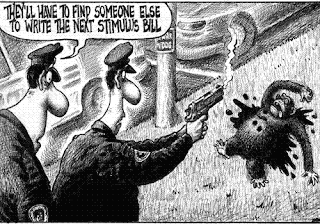
Is this cartoon offensive?


I'm participating in a long-term survey conducted by politicshome.com, pursuant to which I receive one or two emails per week prompting me to answer a short series of opinion questions about the news of the day. This morning, the email contained the following sentence: "Today, we approach the delicate subject of race." I clicked the link, and was greeted with the above cartoon, along with some explanatory text:
The New York Post ran this cartoon in their newspaper yesterday, and it has sparked a controversy. The image is of a chimpanzee having been shot by police. The text reads: "They'll have to find someone else to write the next stimulus bill." Do you think this is offensive?
The media has been all atwitter with the story of the woman in Connecticut who was almost mauled to death by her friend's trippin' pet chimpanzee. After the attack, the owner called 911, and the police were dispatched, at which point they shot and killed the ape. The victim was so badly mutilated that the police thought she was a man when they came upon her body. The last I read, she was in critical but stable condition.

This is what ran through my head when I saw the cartoon. I drew the conclusion that the cartoonist had in mind to intimate that the stimulus was such a poor bill that even a chimpanzee (on downers) could have drafted it. Which is pretty much what you would expect a New York Post cartoonist to say. So was it offensive? I thought that it was somewhat tasteless to take advantage of this lady's plight to make a relatively crass point about a totally unrelated political event, and particularly to do so in such a patently unfunny way. But tasteless isn't offensive. I clicked "No."

Still, I continued to think about it. After all, the email from PoliticsHome had primed me for a question about race. I am an intelligent and educated man, and I am by no means ignorant of the fact that the history of rhetoric regarding race in our nation includes not just a few instances of black men being lumped in with lower primates by people with political and eugenic axes to grind. So I sat a while and tried to spin a sensical interpretation of the cartoon that would play on that outdated and obviously offensive symbolism.

I couldn't come up with anything that made sense to me. For the cartoon to operate in that way, you would have to read it as blaming black people for drafting a shoddy bill, which doesn't fly, since Congress drafted the bill, and most members of Congress are white. Anyway, I finally decided, if there was an offensive racial interpretation to the cartoon, it was too subtle for me to detect, so I left my answer as it was.

It was only later in the morning when I came across editorials by Roland S. Martin and Keith Josef Adkins explaining what was purportedly offensive about the cartoon. Martin writes:
If you haven't seen the editorial in question, it shouldn't take you long to figure out that the subtle message was clear: comparing President Obama to a chimpanzee.
WHOA! Wait a minute! Seriously? I stared at the cartoon for five minutes, actively trying to suss out what was supposed to be racist about it, and I never, NEVER would have made this supposedly obvious connection. It makes no sense at all. President Obama didn't draft the stimulus bill; Congress did.

And now listen to Martin's explanation for why this connection is so obvious:
First, mixing the two stories [the chimp attack and the stimulus] is ridiculous. Yes, the chimpanzee incident and the passage of the stimulus bill have a lot of folks talking, but to put them in the same element just doesn't make sense.

Second, the cartoonist didn't hang a sign around the neck of the chimp, so he left it up to the reader to determine exactly who the cops were referring to.
As to the first argument, about what percentage of the political cartoons that you read make a hell of a lot of sense? My hunch is that this number hovers between 20% and 30%. As to the second, I think it makes my point just as effectively as it makes Martin's own: if it is "left up to the reader to determine exactly who the cops are referring to," doesn't that imply that the reader chooses whether to interpret the cartoon in a way that he or she finds offensive?

Adkins, on the other hand, didn't go out on a limb to say that the cartoon chimp represented Obama in particular, but did write, "I'm sorry, there's no way to interpret a cartoon like this except as racist filth." I just disagree. The cartoon clearly CAN be interpreted as racist filth, but only if the interpreter is predisposed to read racial animus into found cultural objects. I think it can be interpreted as just tactless and unfunny.

Look, I'm not accusing these two columnists, or the many people who agree with them, of manufacturing umbrage in response to the cartoon. I have no reason really to believe that they are being anything but sincere in taking offense to it. I suspect that this is just one area where different upbringings coax out wildly different interpretations of the same cultural object, and not a great deal can be done about that. So I recognize that it's possible to have caused legitimate offense without having intended to do so, and that maybe in such a case, an apology is warranted. But these cases of cross-racial misunderstanding are so common that it's time for both sides to start adjusting their expectations. As a white guy, I just don't have a radar for this stuff. If I offend somebody, it's not insensitivity or malice; it's just that I'm operating on a different set of symbols from the one that would help me avoid putting my foot in my mouth about these things. It's the same way that I can walk past a pile of dishes in the sink for days on end, as Katy steadily boils over in anger: to me, those dishes are not saying "Wash us!"

To finish up, I think it bears saying explicitly that white people generally don't assume that depictions of apes in editorial cartoons are representative of African Americans in general, or of President Obama in particular. Quite the contrary in fact. When I imagine a simian as a symbol for the chief executive, a president of a different vintage comes to mind. Anyone remember the Smirking Chimp?

Federal Funds are Nothing New in Louisiana

Just quickly, I'm noticing that a lot of my more conservative Facebook friends are expressing their pleasure at the fact that Governor Jindal has indicated his willingness to forego the federal stimulus funds allocated to Louisiana in the new bailout package. Granted, Jindal has predicated his position on an abundance of caution, wishing to evaluate the "strings" that may be attached to the funds. But my friends seem to be approving Jindal's move on the more general basis that they oppose Louisiana's acceptance of federal money in principal. (Check out the comments to this blog post from the Huffington Post, for instance).

All I want to say is that as a matter of course, the budgets of every state, including Louisiana, include significant injections of federal funds. Famously, Louisiana long resisted increasing the drinking age to 21, until the U.S. threatened to withhold federal money for highway construction and maintenance unless the drinking age was raised. Louisiana quickly fell in line after that.

Anyway, if you oppose states accepting federal money in principal, you can't start and end your criticism with the stimulus package. There are veins here that run deeper than that.

Monday, February 9, 2009

Kucinich to Citi: "We Own You."

This morning I would have made my conservative father proud. While getting dressed, I quite literally yelled at Dennis Kucinich, who was appearing on CNN, "What are you, some kind of fucking idiot?" Kucinich was bemoaning the fact that Citi, after accepting bailout funds from the federal government, was applying a portion of those funds ($400 M) to become the name sponsor of the New York Mets' new baseball stadium.

Perhaps speaking as a sports fan, Mr. Kucinich's ire could be somewhat justified. I will be the first to admit that, say, the moniker "Minute Maid Park" lacks the magnetic hubris of the late, great "Astrodome." But do I want the federal government messing around with this stuff? No!


"We own you"? Really, Mr. Kucinich? Is that really what you meant to say there? Maybe people would be less put-off by you if only you were a bit less heavyhanded in your approval of actual, state socialism. I'm not the kind of person to make such a charge lightly; in fact, I don't think I've ever called any American politician a socialist, and where I come from, that's saying something.

Maybe it's worth belaboring the obvious on this point: Fortune 500 companies are not in the business of tossing hundreds of millions of dollars into marketing contracts without the prospect of a sizeable return. A part of any major corporate budget is marketing, and to go around clutching one's pearls because the titans of corporate greed failed to suspend their advertising budgets upon receipt of public funds just shows how ignorant (or vindictive) Kucinich and his ilk really are. Advertising is an easy target for these guys, because there's a popular perception that advertising is frivolous business, when really, I think that the perception of frivolity has more to do with the frivolous nature of the public that the ad business must appeal to, than with anything frivolous in the nature of the ad business itself.

Simply put, the money is not being "wasted" just because it's being spent on marketing. Did anybody accuse Apple of wasting money on advertising in the past several years? There are times when the better investment for the future of a business is advertising rather than maintaining jobs. To my knowledge, Citi has not been nationalized as a provider of unemployment benefits, at least not yet.

I don't want to be heard as saying that the mere fact that a large corporation spends its money in a particular way is evidence in itself that the expenditure is a good idea. After all, banks sank billions of dollars into subprime mortgages, and investment banks spent several billion more on the resulting mortgage-backed securities, and those have proven to be disastrous investments. But I think those cases are distinguishable. The mortgage catastrophe has an element of the sorites paradox: a large number of practically identical transactions, no single one of which would have sunk the ship, but whose aggregate effect was to do just that. Nevertheless, in order to be taken in by the logic that because one bad mortgage doesn't kill you, you ought to risk your entire business on bad mortgages required the banks to cultivate systemic ignorance in their employees and management as to one of the most basic functions of any lending institution: managing risk.

By contrast, Citi's purchase of naming rights is a one-off transaction. Sure, it could spell a net loss for Citi, but that's an inappropriate way to evaluate the wisdom of such a unique transaction on the front end. Citi has to evaluate the expected value of the transaction based on what it knows right now; not upon what it will know after twenty years, when the naming agreement terminates. And with a relatively limited number of similar transactions to draw upon, past performance isn't likely to be particularly helpful in this case. I see no good reason to stifle private investment just because a particular transaction happens to be relatively easy to mock.

I am no raving capitalist, but it seems disingenuous to me for the Congress to fail to regulate what the bailout funds could be spent on, and then fly off the handle, threatening hearings and bad press, when the funds were used to pay for perfectly predictable (if not necessarily palatable) expenditures like executive bonuses and advertising. The proper way to channel the funds as Congress intended would have been to attach the strings to the funds on the front end—take it or leave it—not to stage unwarranted attacks ex post. If Congress wanted to put quotas on the number of loans made by Citi and the rest, or on the number of jobs that corporate America should create, then it should have said so in the first place, and conditioned the bailout funds accordingly, since it has the authority to do so. But I seem to recall that Congress' forays into the home loan business had something to do with getting us into this situation in the first place.

Wednesday, January 28, 2009

Congressional Representation for D.C.: Why the Constitution isn't Really such a Big Problem

The District of Columbia presently has no representation in the Congress of the United States. Why not? Because of the Constitution. Art. I, Sec. 2 of our founding document provides:

The House of Representatives shall be composed of Members chosen every second Year by the People of the several States...
Since D.C. is not a state, its people are not constitutionally authorized to elect a member to the House of Representatives. (Art. 1, Sec. 3 makes the same rule applicable to the Senate). If you wonder why this is such an affront, think about every income tax increase, declaration of war, imposition of the draft, etc., in the history of the United States, and recall that the residents of D.C. had no voice in the authorizing legislation, but found themselves just as subject to it as did the citizens of any state. It's practically imperialistic.

There is now a bill in the works to allocate one seat in the House of Representatives to D.C. (No plans for the Senate yet, apparently). The problem is that the bill is almost certainly unconstitutional. Like I pointed out above, the Constitution says if you're not a state, you can't be represented in the House. Not even an act of Congress can change that. It will take a constitutional amendment to properly get D.C. into Congress, just like it took the Twenty-Third Amendment to allow its residents to vote for President.

(There is an interesting Supreme Court Case, Tidewater, holding that Congress could constitutionally treat D.C. as a state for purposes of diversity jurisdiction, even though the text of the Constitution says that diversity jurisdiction only applies to cases and controversies "between Citizens of different States." Tidewater is probably distinguishable though, because the question involved there was not nearly as politically fraught as this one is. A court has inherent authority to determine the limits of its jurisdiction, which is all that the Supreme Court did in Tidewater; courts will tread much more lightly on the turf of the legislative branch.)

Anyway, I was reading today an argument from someone fretting the unconstitutionality issue, but urging the passage of the legislation anyway. His argument was that although the measure would be overturned in court, the legal turmoil would publicize the plight of D.C. residents, laying the groundwork for a later constitutional amendment. I have a better idea. Pass the unconstitutional law and don't sweat it; it will not be overturned anytime soon.

Just because a law is unconstitutional doesn't mean that Joe Schmoe can file a petition in U.S. District Court to have it declared unconstitutional. You have to overcome an initial showing that you have "standing." In general, that means that you have to show that the unconstitutional law is causing you a particularized harm, and that an order from the court will be effective to cease that harm. Now I ask you, who has standing to argue in court that the D.C. representation act ought to be declared unconstitutional? I've come up with two scenarios, both somewhat implausible.
  1. Imagine that after the D.C. Representative is seated, he votes to enact a new federal criminal statute. The measure passes the House by one vote, is passed by the Senate, and signed by the President. Later on, a criminal defendant is indicted under the new measure. The defendant brings a motion to quash the indictment, arguing that he didn't violate the law because there was no law; the bill was never properly passed by the House of Representatives. It was only considered to have passed because of the improperly seated Representative from D.C., whose vote should not have been counted. Now, the issue really is whether the law authorizing a seat in the House for D.C. is constitutional, and the criminal defendant can clearly meet the burden of standing. The situation is implausible because it relies on the bill passing by one vote; otherwise it makes no difference how the Representative from D.C. voted.
  2. The Constitution gives the members of each house the authority judge the "Qualifications of its own Members" (Art. 1 Sec. 5). They can and do sometimes refuse to seat members, as you may recall from part of the Rod Blagojevich scandal. It's not beyond the realm of possibility that the House could refuse to seat a Representative from D.C. on the grounds that his election would have been unconstitutional. If they do so, his recourse is to sue in federal court to have his election declared valid, at which point, the court will have to decide the issue of whether the statute authorizing his election was constitutional. The reason this scenario is implausible is that, assuming the D.C. Represenatation statute passed the House in the first place, it's doubtful that the House members would then turn around and refuse to seat the elected representative. It would take a big shift in the makeup of the House for that turnaround to occur; by the time it does, the congressman from D.C. may already be pretty well entrenched, and the political fallout from the challenge might outweigh the political gain.

Pass this statute because it's the right thing to do for the residents of D.C., and because it stands to actually do some good long before anybody racks up the standing to have it declared unconstitutional.