Microsoft recently launched what it apparently hopes will be a Google-slaying new search engine called Bing. The guys in marketing were apparently quite deliberate in choosing a name for their new search engine that could be conscripted into service as a verb, a la "googling." You can see this in an open letter to users, in which the Bing Team enthuses, "We sincerely hope that the next time you need to make an important decision, you'll Bing and decide."
I spot three problems with this potential verb. First, written in its presumed participial and past tense forms ("binging" and "binged," respectively) "to bing" is indistinguishable from "to binge." That's not the sort of ambiguity that I'd generally like to invite.
Secondly, the nearest English verb prototypes for "to bing" are probably "to bring," "to fling," "to ring," and "to sing," all of which are irregular verbs. You don't form the past tense of any of these verbs by adding -ed. No, you turn them into "brought," "flung," "rang," and "sang." Try those endings out on "to bing": "bought," "bung," "bang." And now see how you like substituting those into the sentence, "Last month, I googled Sonia Sotomayor maybe fifteen different times."
(Imagining "bung" entering the vocabulary as a past tense verb puts an inexplicably resilient smile on my face, I have to admit.)
Lastly, the participial form "binging," is just an unpleasant mouthful to spit out. It rhymes with itself in a cloying, ugly, nasalized guttural way. Those double -ng's are just too much damn work. We put up with them in "bringing," etc., because those are part of our native vocabulary, but no marketing manager is going to get me to use as demonstrably foul-sounding a word as "binging" just because it was the best he could come up with.
The Bing people were right to note that the verb form "to google" gives Google a word of mouth marketing advantage. The word makes for a pleasant mouthfeel. But on the Internet, these verbs spring up all the time, even when they aren't quite so easy and obvious, as long as the service is actually good for something; "to facebook," "to imdb," and even "to wikipedia," are all verbs I've encountered in real life. So I'm partially annoyed that Microsoft ever decided to make the verbiness of its search engine's name central to its ad campaign. Build a better product, and your users will take care of the linguistic bits for you. But what sends me over the edge is that, having decided that it coveted Google's verbiness, Microsoft couldn't come up with a name any less problematic than "Bing" in terms of precision, morphology, and phonology.
Showing posts with label internet. Show all posts
Showing posts with label internet. Show all posts
Friday, June 19, 2009
Tuesday, March 17, 2009
Too Many Friends
Stosh,
We were talking a little while ago about the extent to which going away to college does or doesn't provide an opportunity to reinvent oneself. I came across an article today in the New York Times Magazine proposing that social networking sites might actually make this more difficult, since it's harder for, say, a Facebook user to make a clean break with his high school buddies.
I quote liberally from a passage that resonated strongly with me:
So is the mythos of college as a place for self-reinvention totally contingent upon the inconvenience of keeping up with one's old friends? And do social networking sites disrupt that inconvenience to such an extent that self-reinvention becomes too onerous to consider?
We were talking a little while ago about the extent to which going away to college does or doesn't provide an opportunity to reinvent oneself. I came across an article today in the New York Times Magazine proposing that social networking sites might actually make this more difficult, since it's harder for, say, a Facebook user to make a clean break with his high school buddies.
I quote liberally from a passage that resonated strongly with me:
As a survivor of the postage-stamp era, college was my big chance to doff the roles in my family and community that I had outgrown, to reinvent myself, to get busy with the embarrassing, exciting, muddy, wonderful work of creating an adult identity. Can you really do that with your 450 closest friends watching, all tweeting to affirm ad nauseam your present self?As Sean rightly pointed out, the pressure of one's past can be shut out from the present just by unplugging from one's old friends. I think the reason why in practice nobody ever does this is because, unlike friends who fade away in the real world just because you fail to contact them, Facebook friends hang around until you take the affirmative step of un-friending them. Nobody wants to have to take a step to affirmatively sever a social tie, except in extraordinary circumstances.
So is the mythos of college as a place for self-reinvention totally contingent upon the inconvenience of keeping up with one's old friends? And do social networking sites disrupt that inconvenience to such an extent that self-reinvention becomes too onerous to consider?
Friday, January 16, 2009
Artists Offer Mindblowing APYs on Colossal Certificates of Deposit
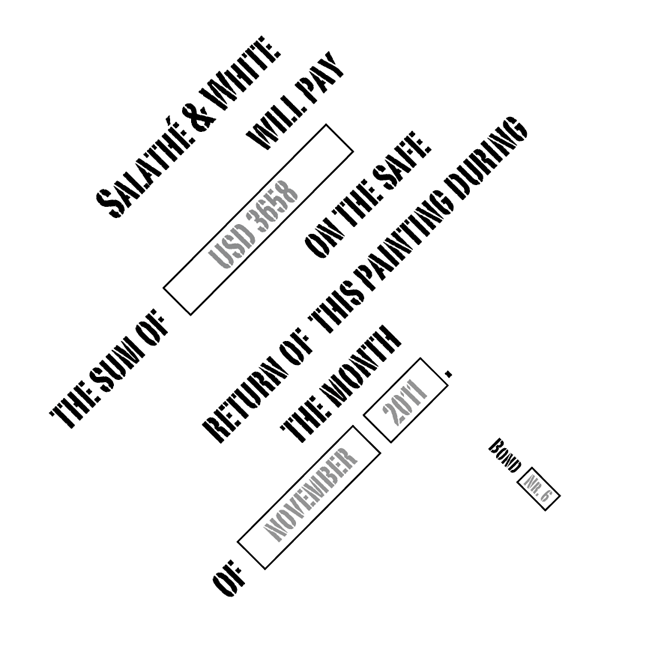 Marcel Salathé and Anthony White are a pair of artists undertaking a somewhat perplexing experiment involving art and economics. They take a canvas, paint words on it promising to pay a certain sum of money to the person who returns it to them, provided that person returns it during the month denoted on the painting. It looks like this.
You can think of it sort of like a certificate of deposit, except that it's on a square yard of canvas, and, if the maturity date expires, it won't roll over into a new CD; instead, you can't redeem it at all after that date.
My expectation would be that the novelty of a giant certificate of deposit that you can hang on the wall of your urban loft-style apartment with exposed ductwork would make these paintings sell at higher prices than CDs of the same face value that you purchase from your bank. Effectively, the artists ought to be able to offer a lower annual percentage yield (APY) than a bank does, because of the purported aesthetic value of the painting. In practice, this expectation has not always been borne out.
 The series so far consists of six paintings, four of which have been sold. The maturity dates of two of the four sold paintings have passed (Bond Nos. 1 and 3). Bond No. 1 is pictured here to my left. Bond No. 1 promised $1,063 if it was returned during February 2008. The piece was sold at auction for $1,286. The painting was not returned, and so the artists netted $1,286. That's a good result for them. Not only did they sell a promise to pay $1,063 for more than $1,063, but the promise lapsed without being enforced. Not bad.
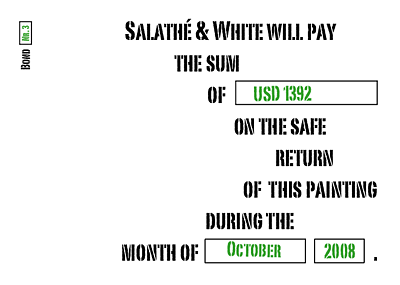 To my right now you'll see Bond No. 3, which promised $1,392 if returned during October 2008. Bond No. 3 was sold at auction on April 29, 2008 for $960, and was returned to the artists in October 2008. The artists then paid the returning party $1,392, and auctioned the painting again on eBay, where it sold this time for $242.50. All told, the artists netted a loss of $189.50 on Bond No. 3.
It seems to me that Bond No. 3 was worth well more than $960 when it was purchased, and that the reason it sold for so little must have had to do with the thin market (i.e., the fact that not many people knew about the auction). If you bought a CD for $960 that promised a return of $1,392 in five months, its interest rate would be 89%. That comes to a 144% APY. For comparison, if you buy a six-month CD from Chase today, it will buy you a measly 0.25% APY. Bond No. 3 was a steal at $960.
After Bond No. 3, the artists apparently learned their lesson, and stopped auctioning the paintings. Instead, they placed a fixed price on them. Bond No. 6, pictured at the top, lists for $2,699, and promises $3,658 if returned in November 2011. The comparable CD would have an interest rate of about 10.4%, for roughly an 11% APY, nowhere near as crazy high as Bond No. 3, but still a much, much better rate of return than would be available from a bank right now. In fact, an 11% APY is higher than you'd ordinarily expect in a decent year from stocks (and Lord knows we may be waiting a long time for another one of those); on a guaranteed investment 11% APY is mind-blowing. I say buy it if you have the cash on hand.
But doesn't this seem strange? Like I said above, the aesthetic value of the art ought to mean that the artists should be able to offer lower yields than banks. Instead they offer higher ones. It's almost like the aesthetic/novelty factor actually makes the painting worth less than a traditional CD. Are Salathé and White making a paradoxical or ironic statement about art values? Or are they just not performing the calculations that would tell them that they are grossly undervaluing their work?
Thursday, January 15, 2009
Marvelous Word Clouds
 Just wanted to post a link to http://www.wordle.net/, which uses a Java applet to generate marvelous word clouds, either made from text you enter on the site, or text it imports from a blog you direct it to. To the right, you'll see the word cloud it generated when it crawled our site. In other news, we are huge nerds.
 I also tried it with some of my old papers from college. Here's the cloud Wordle generated for my paper, "Beauty is Truth: Modern and Medieval Notions of Historicity in The Lord of the Rings."
Saturday, January 3, 2009
Book Review: The Cult of the Amateur by Andrew Keen
I just finished reading Andrew Keen's 2007 book, The Cult of the Amateur. The thesis of the book is that Web 2.0 technologies (think blogging, wikis, social networking, and file sharing) are undermining the cultural and economic institutions that, up until now, have made the world work. In particular, Keen's great phobia is a world where expert opinions are inaudible over the throng of amateurs shouting at each other.
To illustrate that point, Keen tells the story of Dr. William Connolley, a global warming researcher who was editing Wikipedia's "Global Warming" entry. Connolley's Wikipedia permissions were limited when another user (not a global warming researcher) complained that Connolley was "strongly pushing his POV with systematic removal of any POV which does not match his own" (p. 43). Keen's view is that in the ensuing appeals process, the Wikipedia staff should have considered Connolley's expertise and rescinded their order limiting his permissions.
I guess there's something bothersome about the story. It's true that I find myself sympathizing with Connolley. If I wanted facts about global warming, I would trust what he told me more than what the complaining user told me; if the complaining user tried to interrupt his explication in polite conversation, I'd tell the user to shut it, because I'm trying to learn something. But at the end of the day, I just can't get all that riled up about this story. There are plenty of things that Wikipedia is good for, like looking up Bob Dylan's discography, or the average annual rainfall in Rio de Janeiro, or a diagram of a generic drilling rig. But I don't know anybody who thinks that Wikipedia is the place to go to learn the unassailable facts underlying a scientific controversy. Frankly, it probably won't even give you enough background to meaningfully describe the parameters of the debate. In short, the entry on Global Warming is not what Wikipedia is good for. Of course, maybe I'm overestimating people's ability to rationally rate the reliability of information on the web.
Keen makes similar arguments about blogs usurping the role of the traditional media. Again, maybe I'm behind the times, but I don't read blogs to get the news, I read them to get opinions. If a fact sounds fishy, I try to corroborate it at a reputable news site.
In other chapters, Keen takes on the future of music (there will be so much selection that you'll never be able to find anything you like), the future of the book (in which there really is only one text), as well as privacy concerns and the evils of Internet addiction. The book is at its best though when it begins to hint at a sort of malaise infecting the concept of authorship itself. Information technology has progressed to the point where every presently existing art form can be encoded in binary. And with disk space to store the ones and zeros, processors to manipulate them, and networks on which to share them, (what we now call) plagiarism runs rampant, and amateurish remixes and mashups abound.
When the barriers to entry were higher, when it was harder to get eyeballs on your work, only the most talented had any real incentive to try and get "published." Now though the Internet is an echo chamber of mediocrity: a lot of teenagers on Xanga posting their poetry, trolling other teenager's poems, and writing, "I like that - come read one of mine, and leave a comment!" The talented all of a sudden have less to aspire to, because it is harder to see that there is anything fine and glorious and noble left in the work of art.
But all those hard drives and processors and networks make this possible too, and I don't know that I would trade it. It's just that the paradigm of authorship is shifting, and I'm nostalgic for it before it's even all gone.
Anyway, The Cult of the Amateur is one of the more poorly reviewed books that I've ever looked at on Amazon. Maybe you can imagine that there would be a natural bias among online reviewers, but it really does have problems. There are good ideas in there, but they are somewhat inartfully expressed, and I found myself doing most of the mental heavy lifting when it came to organizing and analyzing Keen's ideas. The chapters on privacy and Internet addiction felt sort of tacked-on. Also, the tone in some places is extra curmudgeonly. I can't really recommend it very highly unless the topics interest you on their own; the writing alone will not be enough to hold your interest.
To illustrate that point, Keen tells the story of Dr. William Connolley, a global warming researcher who was editing Wikipedia's "Global Warming" entry. Connolley's Wikipedia permissions were limited when another user (not a global warming researcher) complained that Connolley was "strongly pushing his POV with systematic removal of any POV which does not match his own" (p. 43). Keen's view is that in the ensuing appeals process, the Wikipedia staff should have considered Connolley's expertise and rescinded their order limiting his permissions.
I guess there's something bothersome about the story. It's true that I find myself sympathizing with Connolley. If I wanted facts about global warming, I would trust what he told me more than what the complaining user told me; if the complaining user tried to interrupt his explication in polite conversation, I'd tell the user to shut it, because I'm trying to learn something. But at the end of the day, I just can't get all that riled up about this story. There are plenty of things that Wikipedia is good for, like looking up Bob Dylan's discography, or the average annual rainfall in Rio de Janeiro, or a diagram of a generic drilling rig. But I don't know anybody who thinks that Wikipedia is the place to go to learn the unassailable facts underlying a scientific controversy. Frankly, it probably won't even give you enough background to meaningfully describe the parameters of the debate. In short, the entry on Global Warming is not what Wikipedia is good for. Of course, maybe I'm overestimating people's ability to rationally rate the reliability of information on the web.
Keen makes similar arguments about blogs usurping the role of the traditional media. Again, maybe I'm behind the times, but I don't read blogs to get the news, I read them to get opinions. If a fact sounds fishy, I try to corroborate it at a reputable news site.
In other chapters, Keen takes on the future of music (there will be so much selection that you'll never be able to find anything you like), the future of the book (in which there really is only one text), as well as privacy concerns and the evils of Internet addiction. The book is at its best though when it begins to hint at a sort of malaise infecting the concept of authorship itself. Information technology has progressed to the point where every presently existing art form can be encoded in binary. And with disk space to store the ones and zeros, processors to manipulate them, and networks on which to share them, (what we now call) plagiarism runs rampant, and amateurish remixes and mashups abound.
When the barriers to entry were higher, when it was harder to get eyeballs on your work, only the most talented had any real incentive to try and get "published." Now though the Internet is an echo chamber of mediocrity: a lot of teenagers on Xanga posting their poetry, trolling other teenager's poems, and writing, "I like that - come read one of mine, and leave a comment!" The talented all of a sudden have less to aspire to, because it is harder to see that there is anything fine and glorious and noble left in the work of art.
But all those hard drives and processors and networks make this possible too, and I don't know that I would trade it. It's just that the paradigm of authorship is shifting, and I'm nostalgic for it before it's even all gone.
Anyway, The Cult of the Amateur is one of the more poorly reviewed books that I've ever looked at on Amazon. Maybe you can imagine that there would be a natural bias among online reviewers, but it really does have problems. There are good ideas in there, but they are somewhat inartfully expressed, and I found myself doing most of the mental heavy lifting when it came to organizing and analyzing Keen's ideas. The chapters on privacy and Internet addiction felt sort of tacked-on. Also, the tone in some places is extra curmudgeonly. I can't really recommend it very highly unless the topics interest you on their own; the writing alone will not be enough to hold your interest.
Subscribe to:
Posts (Atom)