Showing posts with label culture. Show all posts

Tuesday, March 17, 2009

Too Many Friends

Stosh,

We were talking a little while ago about the extent to which going away to college does or doesn't provide an opportunity to reinvent oneself. I came across an article today in the New York Times Magazine proposing that social networking sites might actually make this more difficult, since it's harder for, say, a Facebook user to make a clean break with his high school buddies.

I quote liberally from a passage that resonated strongly with me:
As a survivor of the postage-stamp era, college was my big chance to doff the roles in my family and community that I had outgrown, to reinvent myself, to get busy with the embarrassing, exciting, muddy, wonderful work of creating an adult identity. Can you really do that with your 450 closest friends watching, all tweeting to affirm ad nauseam your present self?
As Sean rightly pointed out, the pressure of one's past can be shut out from the present just by unplugging from one's old friends. I think the reason why in practice nobody ever does this is because, unlike friends who fade away in the real world just because you fail to contact them, Facebook friends hang around until you take the affirmative step of un-friending them. Nobody wants to have to take a step to affirmatively sever a social tie, except in extraordinary circumstances.

So is the mythos of college as a place for self-reinvention totally contingent upon the inconvenience of keeping up with one's old friends? And do social networking sites disrupt that inconvenience to such an extent that self-reinvention becomes too onerous to consider?

Friday, March 13, 2009

Bride of Pseudoscience

It's in my nature neither to pay attention to, nor to write about stories as sordid and rubbernecky as this Rihanna-Chris Brown domestic violence story. But upon encountering this gem of a study, I couldn't help but bring it to your attention for your collective ridicule.

The Boston Public Health Commission surveyed 200 Boston youths between ages 12 and 19, "using the Chris Brown-Rihanna case to gauge their attitudes toward teen dating violence." All of the study participants had heard about the incident. Here are some of the results:
  • 71% said arguing was a normal part of a relationship
  • 44% said fighting was a normal part of a relationship
  • 51% said Chris Brown was responsible for the incident
  • 46% said Rihanna was responsible for the incident
  • 52% said both individuals were to blame for the incident, despite knowing at the time that Rihanna had been beaten badly enough to require hospital treatment
  • 35% said the media were treating Rihanna unfairly
  • 52% said the media were treating Chris Brown unfairly
A few of these numbers are troubling. For example, how is it possible for 51% to think Brown is responsible, and for 46% to think Rihanna is responsible, but somehow, for 52% to think both are to blame? Mathematically and logically, it's impossible for more people to affirm the proposition "A & B" than the proposition "A." Does this turn on a subtle connotative difference between "responsibility" and "blame"? Or did the interviewers just ask one too many questions?

Secondly, how is the extent of a person's injuries relevant to determine their responsibility for them? I am right in reading that implication into the fifth statistic, aren't I? I didn't have to go to law school to figure out that the two issues are independent, but I did gor to law school, and we had this pointed out to us a lot of times in Torts. Just commonsensically though, if you step off the curb in front of an oncoming car, your injuries are your responsibility whether the vehicle runs over your foot and breaks your toe, or whether it sends you flying twenty yards and lands you in a full body cast. Liability and damages are independent issues.

Thirdly, and more in line with the presumed intent of the study, who are these 98 idiotic Boston teenagers wandering the streets thinking that a person isn't really to blame if he beats another person so badly that they wind up in the hospital? Are you kidding me? Newsflash, in case any of you happen to be reading: you actually are in control of whether or not you curl your hand into a fist, and hurl it with a high velocity into another person's cheekbone. Strange but true.

As irate as I am about this last statistic, you'd think somebody in the media would be talking about it as well. Wrong. See here and here. What's the most cited statistic culled from the study? I thought you'd never ask:
Of those questioned, ages 12 to 19, 71 percent said that arguing was a normal part of a relationship; 44 percent said fighting was a routine occurrence.
This is the news that has us fretting thusly?:
The results of the survey, conducted by the Boston Public Health Commission across the city and equally among boys and girls, are startling for local health workers who see a generation of youths who seem to have grown accustomed, even insensitive, to domestic violence."

I think you'd have to be pretty jaded if you weren't startled by it," said Casey Corcoran, director of the health commission's new Start Strong program.
I'm appalled. I'm appalled by the implication of these supposedly responsible adults that it is not "normal" to "argue" when you're in a relationship. Conflating disagreement with domestic abuse? Somebody should be ashamed. Woe to the teenager who buys into this crock of shit.

"Fight"? I just can't get too excited about 44% of youth thinking it's normal to "fight" with your significant other, in light of how broad the meaning of "fight" can be. It runs the gamut from simple disagreement, to heated argument, to knock-down-drag-out, to hurling a vase at the wall, to giving your better half two black eyes, and beyond. This continuum spans both acceptable and unacceptable behavior, so it's not very surprising that some kids think fighting is normal. If 44% had said that "physical violence" was normal in a relationship, I could see myself joining the chorus. But that's not what happened here. This study is plainly the unholy spawn of pseudoscience and tabloid publishing, so why are there people taking it seriously?

Thursday, February 19, 2009

Racist? Really?

Is this cartoon offensive?
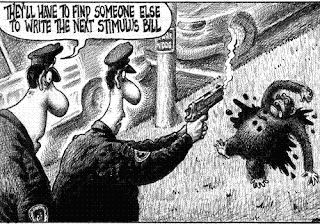

I'm participating in a long-term survey conducted by politicshome.com, pursuant to which I receive one or two emails per week prompting me to answer a short series of opinion questions about the news of the day. This morning, the email contained the following sentence: "Today, we approach the delicate subject of race." I clicked the link, and was greeted with the above cartoon, along with some explanatory text:
The New York Post ran this cartoon in their newspaper yesterday, and it has sparked a controversy. The image is of a chimpanzee having been shot by police. The text reads: "They'll have to find someone else to write the next stimulus bill." Do you think this is offensive?
The media has been all atwitter with the story of the woman in Connecticut who was almost mauled to death by her friend's trippin' pet chimpanzee. After the attack, the owner called 911, and the police were dispatched, at which point they shot and killed the ape. The victim was so badly mutilated that the police thought she was a man when they came upon her body. The last I read, she was in critical but stable condition.

This is what ran through my head when I saw the cartoon. I drew the conclusion that the cartoonist had in mind to intimate that the stimulus was such a poor bill that even a chimpanzee (on downers) could have drafted it. Which is pretty much what you would expect a New York Post cartoonist to say. So was it offensive? I thought that it was somewhat tasteless to take advantage of this lady's plight to make a relatively crass point about a totally unrelated political event, and particularly to do so in such a patently unfunny way. But tasteless isn't offensive. I clicked "No."

Still, I continued to think about it. After all, the email from PoliticsHome had primed me for a question about race. I am an intelligent and educated man, and I am by no means ignorant of the fact that the history of rhetoric regarding race in our nation includes not just a few instances of black men being lumped in with lower primates by people with political and eugenic axes to grind. So I sat a while and tried to spin a sensical interpretation of the cartoon that would play on that outdated and obviously offensive symbolism.

I couldn't come up with anything that made sense to me. For the cartoon to operate in that way, you would have to read it as blaming black people for drafting a shoddy bill, which doesn't fly, since Congress drafted the bill, and most members of Congress are white. Anyway, I finally decided, if there was an offensive racial interpretation to the cartoon, it was too subtle for me to detect, so I left my answer as it was.

It was only later in the morning when I came across editorials by Roland S. Martin and Keith Josef Adkins explaining what was purportedly offensive about the cartoon. Martin writes:
If you haven't seen the editorial in question, it shouldn't take you long to figure out that the subtle message was clear: comparing President Obama to a chimpanzee.
WHOA! Wait a minute! Seriously? I stared at the cartoon for five minutes, actively trying to suss out what was supposed to be racist about it, and I never, NEVER would have made this supposedly obvious connection. It makes no sense at all. President Obama didn't draft the stimulus bill; Congress did.

And now listen to Martin's explanation for why this connection is so obvious:
First, mixing the two stories [the chimp attack and the stimulus] is ridiculous. Yes, the chimpanzee incident and the passage of the stimulus bill have a lot of folks talking, but to put them in the same element just doesn't make sense.

Second, the cartoonist didn't hang a sign around the neck of the chimp, so he left it up to the reader to determine exactly who the cops were referring to.
As to the first argument, about what percentage of the political cartoons that you read make a hell of a lot of sense? My hunch is that this number hovers between 20% and 30%. As to the second, I think it makes my point just as effectively as it makes Martin's own: if it is "left up to the reader to determine exactly who the cops are referring to," doesn't that imply that the reader chooses whether to interpret the cartoon in a way that he or she finds offensive?

Adkins, on the other hand, didn't go out on a limb to say that the cartoon chimp represented Obama in particular, but did write, "I'm sorry, there's no way to interpret a cartoon like this except as racist filth." I just disagree. The cartoon clearly CAN be interpreted as racist filth, but only if the interpreter is predisposed to read racial animus into found cultural objects. I think it can be interpreted as just tactless and unfunny.

Look, I'm not accusing these two columnists, or the many people who agree with them, of manufacturing umbrage in response to the cartoon. I have no reason really to believe that they are being anything but sincere in taking offense to it. I suspect that this is just one area where different upbringings coax out wildly different interpretations of the same cultural object, and not a great deal can be done about that. So I recognize that it's possible to have caused legitimate offense without having intended to do so, and that maybe in such a case, an apology is warranted. But these cases of cross-racial misunderstanding are so common that it's time for both sides to start adjusting their expectations. As a white guy, I just don't have a radar for this stuff. If I offend somebody, it's not insensitivity or malice; it's just that I'm operating on a different set of symbols from the one that would help me avoid putting my foot in my mouth about these things. It's the same way that I can walk past a pile of dishes in the sink for days on end, as Katy steadily boils over in anger: to me, those dishes are not saying "Wash us!"

To finish up, I think it bears saying explicitly that white people generally don't assume that depictions of apes in editorial cartoons are representative of African Americans in general, or of President Obama in particular. Quite the contrary in fact. When I imagine a simian as a symbol for the chief executive, a president of a different vintage comes to mind. Anyone remember the Smirking Chimp?

Saturday, January 3, 2009

Book Review: The Cult of the Amateur by Andrew Keen

I just finished reading Andrew Keen's 2007 book, The Cult of the Amateur. The thesis of the book is that Web 2.0 technologies (think blogging, wikis, social networking, and file sharing) are undermining the cultural and economic institutions that, up until now, have made the world work. In particular, Keen's great phobia is a world where expert opinions are inaudible over the throng of amateurs shouting at each other.

To illustrate that point, Keen tells the story of Dr. William Connolley, a global warming researcher who was editing Wikipedia's "Global Warming" entry. Connolley's Wikipedia permissions were limited when another user (not a global warming researcher) complained that Connolley was "strongly pushing his POV with systematic removal of any POV which does not match his own" (p. 43). Keen's view is that in the ensuing appeals process, the Wikipedia staff should have considered Connolley's expertise and rescinded their order limiting his permissions.

I guess there's something bothersome about the story. It's true that I find myself sympathizing with Connolley. If I wanted facts about global warming, I would trust what he told me more than what the complaining user told me; if the complaining user tried to interrupt his explication in polite conversation, I'd tell the user to shut it, because I'm trying to learn something. But at the end of the day, I just can't get all that riled up about this story. There are plenty of things that Wikipedia is good for, like looking up Bob Dylan's discography, or the average annual rainfall in Rio de Janeiro, or a diagram of a generic drilling rig. But I don't know anybody who thinks that Wikipedia is the place to go to learn the unassailable facts underlying a scientific controversy. Frankly, it probably won't even give you enough background to meaningfully describe the parameters of the debate. In short, the entry on Global Warming is not what Wikipedia is good for. Of course, maybe I'm overestimating people's ability to rationally rate the reliability of information on the web.

Keen makes similar arguments about blogs usurping the role of the traditional media. Again, maybe I'm behind the times, but I don't read blogs to get the news, I read them to get opinions. If a fact sounds fishy, I try to corroborate it at a reputable news site.

In other chapters, Keen takes on the future of music (there will be so much selection that you'll never be able to find anything you like), the future of the book (in which there really is only one text), as well as privacy concerns and the evils of Internet addiction. The book is at its best though when it begins to hint at a sort of malaise infecting the concept of authorship itself. Information technology has progressed to the point where every presently existing art form can be encoded in binary. And with disk space to store the ones and zeros, processors to manipulate them, and networks on which to share them, (what we now call) plagiarism runs rampant, and amateurish remixes and mashups abound.

When the barriers to entry were higher, when it was harder to get eyeballs on your work, only the most talented had any real incentive to try and get "published." Now though the Internet is an echo chamber of mediocrity: a lot of teenagers on Xanga posting their poetry, trolling other teenager's poems, and writing, "I like that - come read one of mine, and leave a comment!" The talented all of a sudden have less to aspire to, because it is harder to see that there is anything fine and glorious and noble left in the work of art.

But all those hard drives and processors and networks make this possible too, and I don't know that I would trade it. It's just that the paradigm of authorship is shifting, and I'm nostalgic for it before it's even all gone.

Anyway, The Cult of the Amateur is one of the more poorly reviewed books that I've ever looked at on Amazon. Maybe you can imagine that there would be a natural bias among online reviewers, but it really does have problems. There are good ideas in there, but they are somewhat inartfully expressed, and I found myself doing most of the mental heavy lifting when it came to organizing and analyzing Keen's ideas. The chapters on privacy and Internet addiction felt sort of tacked-on. Also, the tone in some places is extra curmudgeonly. I can't really recommend it very highly unless the topics interest you on their own; the writing alone will not be enough to hold your interest.