Showing posts with label media criticism. Show all posts

Thursday, May 28, 2009

The Sotomayor Nomination

Yesterday, I came across this in an opinion piece by Ilya Shapiro posted on cnn.com, criticizing President Obama's nomination of Judge Sonia Sotomayor to the Supreme Court:

[I]n over 10 years on the Second Circuit, she has not issued any important decisions or made a name for herself as a legal scholar or particularly respected jurist. In picking a case to highlight during his introduction of the nominee, President Obama had to go back to her days as a trial judge and a technical ruling that ended the 1994-95 baseball strike.

Moreover, Sotomayor has a mixed reputation among lawyers who have practiced before her, some questioning her abilities as a judicial craftsman, others her erratic temperament, according to a piece by Jeffrey Rosen in The New Republic, which itself has come in for criticism.

Such anecdotal criticism is to be taken with a grain of salt -- while Justice Antonin Scalia's bench-side manner is more vinegar than honey, even his detractors recognize his brilliance -- but it does need to be investigated. So, too, do certain statements she made in presentations at Berkeley and Duke, respectively, the former arguing that a Latina necessarily sees the law differently than a white man, the latter suggesting that, at least to some degree, judges make rather than interpret law.
Am I correct in reading this to mean that Shapiro's primary beef with Sotomayor is her lack of "brilliance"? I mean, he shrugs off criticisms of her demeanor (apparently on the grounds that any failing of Antonin Scalia's must not be a failing at all), but huffs and puffs that she is no "legal scholar," "respected jurist," or "judicial craftsman." Seriously, how important is brilliance?

Here's a lesson from the real world and the practice of law: past a certain point, additional intelligence provides only short-term advantages. Being smart means you'll pick up the concepts more quickly than others. It means you might be able to come up with cleverer or more intricate arguments, more quickly. But over the long haul, those benefits never trump experience in the trenches. Yes, the Supreme Court is a very important post, and an impressive intellect is an asset; but an astounding intellect is unnecessary.

Secondly, there seems to be something hypocritical (or at least dissembling) about Shapiro's admonition that Sotomayor "has not issued any important decisions or made a name for herself as a legal scholar or particularly respected jurist." To me, this reads as follows: "Judge Sotomayor has failed to leave a satisfactory smoking gun evidencing her liberal activism, which makes my job difficult, since I'm supposed to call her a liberal judicial activist. Therefore, I will paint her failure to stake out such liberal positions as evidence of her intellectual lethargy." In other words, had Sotomayor staked out any clever, novel, or interesting legal positions, Shapiro would be criticizing her for having taken those positions, instead of criticizing her, as he does here, for not having taken them.

Thirdly, Shapiro criticizes Sotomayor for commenting that judges make rather than interpret the law. If you read Shapiro's bio, you will see that he is a lawyer with an impressive-sounding resumé. This is surprising, because he is apparently quite a dim bulb himself. I attended a state law school, where I was taught by outspoken liberals and outspoken conservatives. Not one of them, regardless of their political persuasion, would have denied that in certain circumstances, a judge has the responsibility to make the law. "Interpreting, not making, the law," is something the public likes to hear about its judges, but it has never been the whole story.

Imagine this scenario: a criminal defendant has been tried in state court and found guilty of first degree murder. The jury deliberates, and votes 11-1 to impose the death penalty. A state statute provides that an 11-1 vote is all that is necessary to impose the death penalty. The defendant objects, saying that the state statute violates the Due Process clause of the Fourteenth Amendment, which ought to be interpreted to require unanimity in order to impose the death penalty. All the Due Process clause says is "No State shall... deprive any person of life, liberty, or property, without due process of law." So which is it? Does the Due Process clause require unanimity or is 11-1 good enough? Either answer is plausible, but you can't support either one just from reading the Due Process clause. Say yes or say no, but your decision is not extrapolated from the meaning of the phrase "due process"; your decision gives meaning to the phrase "due process."

The take-away point is this: when the drafters of the Constitution or the legislation punt, the judiciary has to pick up the ball.

Lastly (for now), Shapiro criticizes Sotomayor for remarking that a Latina and a white man necessarily view the law differently. I actually can join Shapiro in being a little riled by this comment. Obviously she's playing to crude racial stereotypes here. Behind it is something like the ethnic imaginings typified in Jennifer Lopez romantic comedies: Latinas are all sassy hotel maids, and white men are all running for the U.S. Senate. You might as well say that black men and Sicilians necessarily have different views on the law—but then how do you explain Justices Thomas and Scalia? These are oversimplifications that should make us all blush, and frankly they're offensive.

On the other hand, by adding a little nuance, I don't think Sotomayor is very far from the truth. I think it's true to say that there are a lot of factors that influence one's view of the law (upbringing, religion, socioeconomic status, etc.), and many of those factors, statistically speaking, break along ethnic, racial, and gender lines. Because I am charitably-inclined, I'll spot her the benefit of the doubt, and assume that Sotomayor's comment was just ill-advised shorthand for the more nuanced version I've put forth.
Friday, March 13, 2009

Bride of Pseudoscience

It's in my nature neither to pay attention to, nor to write about stories as sordid and rubbernecky as this Rihanna-Chris Brown domestic violence story. But upon encountering this gem of a study, I couldn't help but bring it to your attention for your collective ridicule.

The Boston Public Health Commission surveyed 200 Boston youths between ages 12 and 19, "using the Chris Brown-Rihanna case to gauge their attitudes toward teen dating violence." All of the study participants had heard about the incident. Here are some of the results:
  • 71% said arguing was a normal part of a relationship
  • 44% said fighting was a normal part of a relationship
  • 51% said Chris Brown was responsible for the incident
  • 46% said Rihanna was responsible for the incident
  • 52% said both individuals were to blame for the incident, despite knowing at the time that Rihanna had been beaten badly enough to require hospital treatment
  • 35% said the media were treating Rihanna unfairly
  • 52% said the media were treating Chris Brown unfairly
A few of these numbers are troubling. For example, how is it possible for 51% to think Brown is responsible, and for 46% to think Rihanna is responsible, but somehow, for 52% to think both are to blame? Mathematically and logically, it's impossible for more people to affirm the proposition "A & B" than the proposition "A." Does this turn on a subtle connotative difference between "responsibility" and "blame"? Or did the interviewers just ask one too many questions?

Secondly, how is the extent of a person's injuries relevant to determine their responsibility for them? I am right in reading that implication into the fifth statistic, aren't I? I didn't have to go to law school to figure out that the two issues are independent, but I did gor to law school, and we had this pointed out to us a lot of times in Torts. Just commonsensically though, if you step off the curb in front of an oncoming car, your injuries are your responsibility whether the vehicle runs over your foot and breaks your toe, or whether it sends you flying twenty yards and lands you in a full body cast. Liability and damages are independent issues.

Thirdly, and more in line with the presumed intent of the study, who are these 98 idiotic Boston teenagers wandering the streets thinking that a person isn't really to blame if he beats another person so badly that they wind up in the hospital? Are you kidding me? Newsflash, in case any of you happen to be reading: you actually are in control of whether or not you curl your hand into a fist, and hurl it with a high velocity into another person's cheekbone. Strange but true.

As irate as I am about this last statistic, you'd think somebody in the media would be talking about it as well. Wrong. See here and here. What's the most cited statistic culled from the study? I thought you'd never ask:
Of those questioned, ages 12 to 19, 71 percent said that arguing was a normal part of a relationship; 44 percent said fighting was a routine occurrence.
This is the news that has us fretting thusly?:
The results of the survey, conducted by the Boston Public Health Commission across the city and equally among boys and girls, are startling for local health workers who see a generation of youths who seem to have grown accustomed, even insensitive, to domestic violence."

I think you'd have to be pretty jaded if you weren't startled by it," said Casey Corcoran, director of the health commission's new Start Strong program.
I'm appalled. I'm appalled by the implication of these supposedly responsible adults that it is not "normal" to "argue" when you're in a relationship. Conflating disagreement with domestic abuse? Somebody should be ashamed. Woe to the teenager who buys into this crock of shit.

"Fight"? I just can't get too excited about 44% of youth thinking it's normal to "fight" with your significant other, in light of how broad the meaning of "fight" can be. It runs the gamut from simple disagreement, to heated argument, to knock-down-drag-out, to hurling a vase at the wall, to giving your better half two black eyes, and beyond. This continuum spans both acceptable and unacceptable behavior, so it's not very surprising that some kids think fighting is normal. If 44% had said that "physical violence" was normal in a relationship, I could see myself joining the chorus. But that's not what happened here. This study is plainly the unholy spawn of pseudoscience and tabloid publishing, so why are there people taking it seriously?

Monday, February 23, 2009

Letter to the Editor: Wired Magazine

It's not every day that I get to correct a major publication on some of the finer points of probability, so when the chance comes up, I take it. The full article is here, and the erroneous passage is contained in the fourth paragraph from the bottom of this page. I wrote:
"A Formula for Disaster" is a relatively informative article on one of the causes of the current financial mess, but it bears pointing out that one of Mr. Salmon's illustrations of the concept of mathematical correlation is misleading. In particular, Salmon writes, "And if Britney wins the class spelling bee, the chance of Alice winning it is zero, which means the correlation is negative: -1." It's true that this correlation is always negative, but the numerical value of the correlation is dependent upon the number of students in the class with Alice and Britney. In fact, the correlation of A and B will only be equal to -1 in the degenerate case where Alice and Britney are the only two students in the class. In general, assuming that every student in the class has an equal probability of winning the spelling bee (and that these probabilities can be accurately modeled as Bernoulli random variables), the correlation between A and B will be equal to 1/(1-n), where n is the total number of students in the class.
Wired is one publication where writing in geekspeak might actually increase your chances of getting your letter published, so I went all out. Sean, would you mind checking my math?

Thursday, February 19, 2009

Racist? Really?

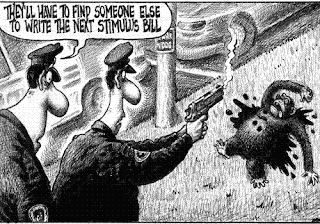
Is this cartoon offensive?


I'm participating in a long-term survey conducted by politicshome.com, pursuant to which I receive one or two emails per week prompting me to answer a short series of opinion questions about the news of the day. This morning, the email contained the following sentence: "Today, we approach the delicate subject of race." I clicked the link, and was greeted with the above cartoon, along with some explanatory text:
The New York Post ran this cartoon in their newspaper yesterday, and it has sparked a controversy. The image is of a chimpanzee having been shot by police. The text reads: "They'll have to find someone else to write the next stimulus bill." Do you think this is offensive?
The media has been all atwitter with the story of the woman in Connecticut who was almost mauled to death by her friend's trippin' pet chimpanzee. After the attack, the owner called 911, and the police were dispatched, at which point they shot and killed the ape. The victim was so badly mutilated that the police thought she was a man when they came upon her body. The last I read, she was in critical but stable condition.

This is what ran through my head when I saw the cartoon. I drew the conclusion that the cartoonist had in mind to intimate that the stimulus was such a poor bill that even a chimpanzee (on downers) could have drafted it. Which is pretty much what you would expect a New York Post cartoonist to say. So was it offensive? I thought that it was somewhat tasteless to take advantage of this lady's plight to make a relatively crass point about a totally unrelated political event, and particularly to do so in such a patently unfunny way. But tasteless isn't offensive. I clicked "No."

Still, I continued to think about it. After all, the email from PoliticsHome had primed me for a question about race. I am an intelligent and educated man, and I am by no means ignorant of the fact that the history of rhetoric regarding race in our nation includes not just a few instances of black men being lumped in with lower primates by people with political and eugenic axes to grind. So I sat a while and tried to spin a sensical interpretation of the cartoon that would play on that outdated and obviously offensive symbolism.

I couldn't come up with anything that made sense to me. For the cartoon to operate in that way, you would have to read it as blaming black people for drafting a shoddy bill, which doesn't fly, since Congress drafted the bill, and most members of Congress are white. Anyway, I finally decided, if there was an offensive racial interpretation to the cartoon, it was too subtle for me to detect, so I left my answer as it was.

It was only later in the morning when I came across editorials by Roland S. Martin and Keith Josef Adkins explaining what was purportedly offensive about the cartoon. Martin writes:
If you haven't seen the editorial in question, it shouldn't take you long to figure out that the subtle message was clear: comparing President Obama to a chimpanzee.
WHOA! Wait a minute! Seriously? I stared at the cartoon for five minutes, actively trying to suss out what was supposed to be racist about it, and I never, NEVER would have made this supposedly obvious connection. It makes no sense at all. President Obama didn't draft the stimulus bill; Congress did.

And now listen to Martin's explanation for why this connection is so obvious:
First, mixing the two stories [the chimp attack and the stimulus] is ridiculous. Yes, the chimpanzee incident and the passage of the stimulus bill have a lot of folks talking, but to put them in the same element just doesn't make sense.

Second, the cartoonist didn't hang a sign around the neck of the chimp, so he left it up to the reader to determine exactly who the cops were referring to.
As to the first argument, about what percentage of the political cartoons that you read make a hell of a lot of sense? My hunch is that this number hovers between 20% and 30%. As to the second, I think it makes my point just as effectively as it makes Martin's own: if it is "left up to the reader to determine exactly who the cops are referring to," doesn't that imply that the reader chooses whether to interpret the cartoon in a way that he or she finds offensive?

Adkins, on the other hand, didn't go out on a limb to say that the cartoon chimp represented Obama in particular, but did write, "I'm sorry, there's no way to interpret a cartoon like this except as racist filth." I just disagree. The cartoon clearly CAN be interpreted as racist filth, but only if the interpreter is predisposed to read racial animus into found cultural objects. I think it can be interpreted as just tactless and unfunny.

Look, I'm not accusing these two columnists, or the many people who agree with them, of manufacturing umbrage in response to the cartoon. I have no reason really to believe that they are being anything but sincere in taking offense to it. I suspect that this is just one area where different upbringings coax out wildly different interpretations of the same cultural object, and not a great deal can be done about that. So I recognize that it's possible to have caused legitimate offense without having intended to do so, and that maybe in such a case, an apology is warranted. But these cases of cross-racial misunderstanding are so common that it's time for both sides to start adjusting their expectations. As a white guy, I just don't have a radar for this stuff. If I offend somebody, it's not insensitivity or malice; it's just that I'm operating on a different set of symbols from the one that would help me avoid putting my foot in my mouth about these things. It's the same way that I can walk past a pile of dishes in the sink for days on end, as Katy steadily boils over in anger: to me, those dishes are not saying "Wash us!"

To finish up, I think it bears saying explicitly that white people generally don't assume that depictions of apes in editorial cartoons are representative of African Americans in general, or of President Obama in particular. Quite the contrary in fact. When I imagine a simian as a symbol for the chief executive, a president of a different vintage comes to mind. Anyone remember the Smirking Chimp?

Monday, February 16, 2009

Puzzling Over Some Wacky Ideas about Teenagers, Sex, Technology, and the Law

For as long as I have been a reader of Slate, which probably goes back to around 2001, I have been a fan of Dahlia Lithwick's writing for the online magazine. Even before I'd settled on attending law school after graduation from college, I'd long enjoyed her Supreme Court Dispatches series, which summarized the facts of many of the more notorious cases on the Court's docket, the legal issues attending thereto, and often included transcriptions of the more raucous parts of the oral arguments. Good, good fun, to watch the Court, and especially to do so in the company of such an astute and professional Court-watcher as Lithwick.

Lately though, Lithwick's columns are falling short. A lot of her recent articles on Slate have been cross-published in Newsweek, and those articles have proven particularly lackluster. This weekend, she weighed in on what has become a trend in adolescent circles, namely "sexting," which apparently means taking nude photographs of oneself and electronically transmitting them to other teens. In a number of cases cited in the article, senders and recipients of the sext messages have been charged with crimes related to child pornography. Lithwick forcefully argues that such charges are inappropriate.

We'll assume for the sake of argument that the photographs in question actually qualify as prohibited child pornography in the prosecuting jurisdictions. It turns out though that this assumption may not be warranted in all cases. For instance, in Louisiana, the crime of pornography involving juveniles is governed by La. R.S. 14:81.1. Under that statute, a depiction of "sexual conduct" is required in order to cross the threshold of criminality, and "sexual conduct" is defined as "actual or simulated sexual intercourse, deviate sexual intercourse, sexual bestiality, masturbation, sadomasochistic abuse, or lewd exhibition of the genitals." From this language, it's not clear that a simple nude photograph would be covered; cases would presumably turn on how "lewd" a particular exhibition of the genitals might be.

Anyway, like I said, let's assume that the jurisdictions in question have broader anti-porn laws, or that the photos forming the basis for prosecution are particularly "lewd." Why then should they not be prosecuted? Lithwick can speak for herself:
One quick clue that the criminal justice system is probably not the best venue for addressing the sexting crisis? A survey of the charges brought in the cases reflects that—depending on the jurisdiction—prosecutors have charged the senders of smutty photos, the recipients of smutty photos, those who save the smutty photos, and the hapless forwarders of smutty photos with the same crime: child pornography. Who is the victim here and who is the perpetrator? Everybody and nobody.
Lithwick seems to be suggesting that, in these limited circumstances, child porn is a victimless crime. Of course, you could point to the analogous case of a drug deal: both the seller and the buyer can be charged with a crime. It's equally difficult in that case to identify a "victim," but nobody seriously thinks that a clearly identifiable "victim" is a prerequisite to a certain act being declared criminal. In the case of both illegal drugs and child pornography, the justification for criminalization is the same: when certain revenue streams cause aggregate damage to the physical, mental, or sexual health of the public, those revenue streams ought to be shut down.

Lithwick quotes a police captain in a Pennsylvania case, who argues that the prosecutions are justified, saying, "Once it's on a cell phone, that cell phone can be put on the Internet where everyone in the world can get access to that juvenile picture." She then trivializes his argument, writing:
The argument that we must prosecute kids as the producers and purveyors of kiddie porn because they are too dumb to understand that their seemingly innocent acts can hurt them goes beyond paternalism. Child pornography laws intended to protect children should not be used to prosecute and then label children as sex offenders.
Parenthetically, I'll admit that Lithwick is right on when she says that registration as a sex offender would be an inappropriate punishment for teenage sexting. Those registries are supposed to identify criminal sexual deviants, and whether it's good behavior or bad, nobody ought to maintain that the urges that lead to teen-to-teen sexting are anything other than mainstream.

But again, Lithwick's rush to identify the victim throws her off the scent of what's really going on here. This is not an exercise in paternalism meant to protect the interests of emptyheaded would-be teen sexters. Child porn statutes are meant to shut down commercial activity in contraband, and it is reasonable in that light to enact laws that would curtail production of contraband, including small-scale production.

And besides, the prosecuted teens will ordinarily be benefited by the same procedural safeguard afforded to minors generally in the legal system: prosecution before a specialized juvenile court, with relaxed formalities. Imagine yourself as the juvenile judge before whom a sexting case is brought. You have wide latitude in terms of punishment. Do you really want to put a teen sexter in juvy, much less in prison? No! Your role is the same as it is in the vast majority of other juvenile prosecutions: to ensure the offenders understand the gravity of the situation, the reasons why their conduct is prohibited, and to scare them a little bit. Then you assign them a few hours of community service. In other words, teenagers are already benefited by regulations meant to ensure that their punishment reflects their relative level of informal culpability.

But here's where Lithwick completely loses me, and it's a matter of sort of general penology, rather than something specific to sexting:
Many other experts insist the sexting trend hurts teen girls more than boys, fretting that they feel "pressured" to take and send naked photos. Yet the girls in the Pennsylvania case were charged with "manufacturing, disseminating or possessing child pornography" while the boys were merely charged with possession. This disparity seems increasingly common. If we are worried about the poor girls pressured into exposing themselves, why are we treating them more harshly than the boys?
Allow me to retort with an example from physics. Suppose 10 pounds of force is being applied to an object, but you want the object to stay put. What should you do? Apply 10 pounds of force in the opposite direction. But if 100 pounds of force is being applied, 10 pounds won't be enough; instead you should apply 100 pounds. In other words, if you want to curtail girls sending naked pictures of themselves to boys, and they feel intense peer pressure to do so, a seemingly plausible course of action would be to push back harder, by increasing the applicable punishment to such an extent that it balances or overcomes peer pressure.

Now obviously I make no claims to expertise in child psychology, and can't vouch for whether the push-pushback illustration accurately models a workable incentive structure for teenage girls thinking about sex. But it passes the smell test anyway. Even if it's wrong, it's at least on the side of common sense, so that I think anyone who would take the contra bears the burden of showing why such an incentive structure won't work. Certainly it's not as mystifying as Lithwick seems so hellbent on implying.

But then again, maybe Dahlia's right. I mean, gang initiates feel intense peer pressure to commit murder. So maybe we shouldn't be so hard on them.